

Eisgruber discusses budget cuts, housing, and higher education challenges at Princeton council meeting
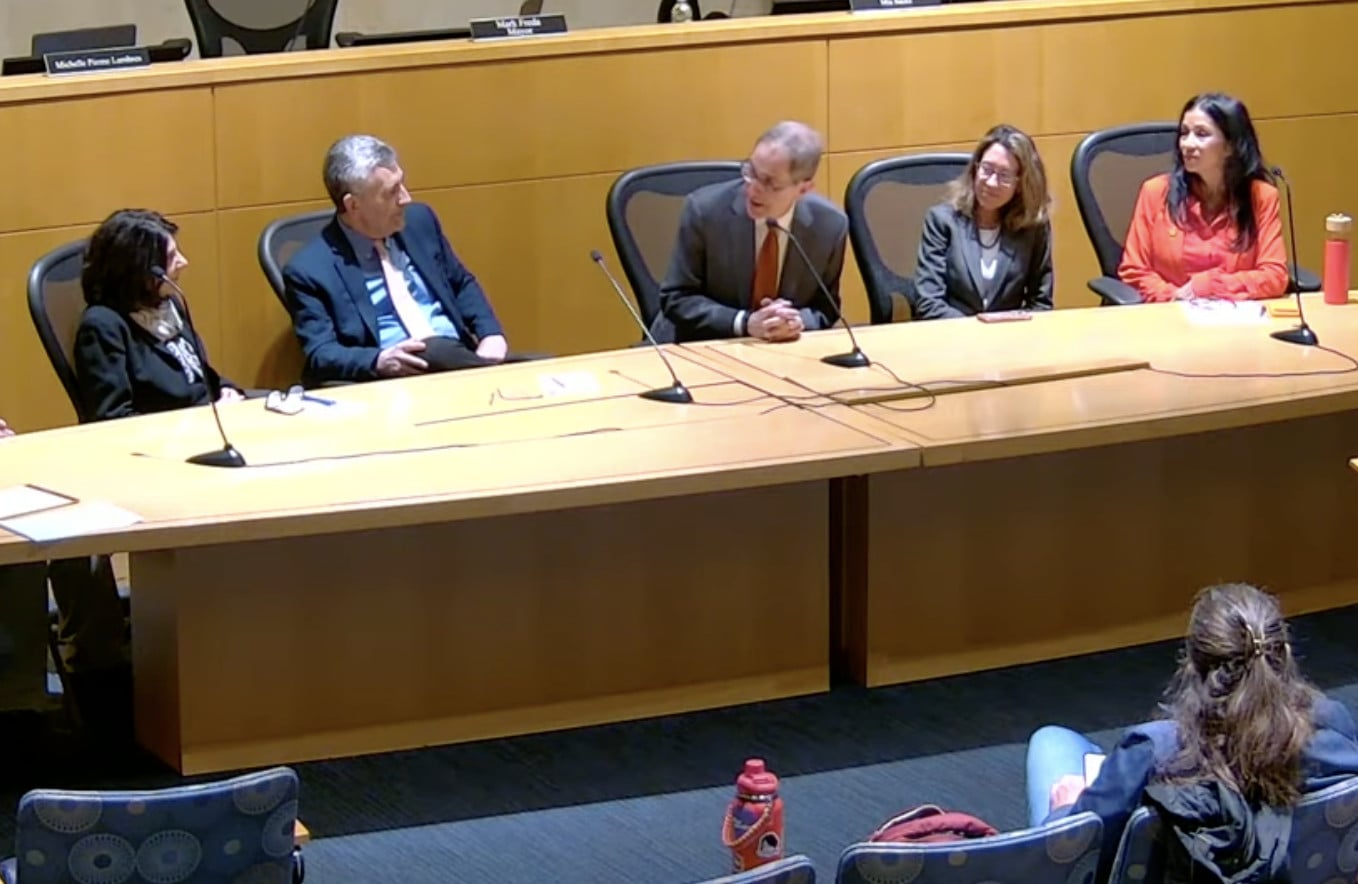
Princeton University President Christopher Eisgruber told municipal officials this week that the university is entering a period of tighter financial constraints even as it continues to invest in its academic mission and its relationship with the town.
Speaking at the Princeton Council meeting on March 23, Eisgruber described a shift from years of growth to what he called a period requiring “focus and a set of choices,” driven by economic pressures, threats to government funding, and concerns about academic freedom.
“This is now my 13th year coming to speak with this council,” Eisgruber said, calling the longstanding partnership between the university and the municipality “one that certainly matters greatly.”
Financial headwinds and budget cuts
Eisgruber said Princeton has already implemented budget reductions of 5% to 10% across most departments and expects additional constraints in the years ahead.
The university, which relies heavily on its endowment, is facing declining long-term investment returns, he said. While Princeton historically averaged about 12% annual returns, projections now hover closer to 8%, the minimum needed to sustain operations, financial aid, and salaries.
“That means we’re not going to have that kind of margin in the endowment to leverage,” he said.
As a result, the university has made difficult decisions, including freezing salaries for tenured faculty and limiting staff raises to 1%. Rising health care costs have also added pressure to the budget.
Despite the constraints, Eisgruber said Princeton remains financially strong and committed to affordability and academic excellence.
“We are going to continue to be able to maintain our commitment to affordability and access,” he said.
He also reaffirmed the university’s pledge to increase its voluntary financial contribution to the municipality by 4% annually under an existing agreement.
Growth, investments, and community impact
Eisgruber pointed to recent achievements, including the completion of the university’s “Venture Forward” capital campaign, which funded major investments in facilities and programs, including a new bioengineering institute, expanded undergraduate enrollment, and new pathways for military veterans and community college transfer students.
He also highlighted the opening of the Princeton University Art Museum, which he said has drawn visitors to campus, supporting the local economy in the process.
“I see them eating at our restaurants in town. I see them buying things from merchants on Nassau Street,” he said.
Additional projects include new graduate student housing and a campus health center focused on student well-being.
Calls for deeper collaboration on housing
Council members used the meeting to raise concerns about housing affordability and to propose deeper collaboration between the university and the municipality.
Councilman Leighton Newlin outlined a vision for a formal partnership between Princeton University and the Princeton Housing Authority to develop mixed-income, affordable housing.
“This is not about charity … it’s about alignment,” Newlin said, emphasizing the need to ensure that people who work in Princeton can afford to live there.
He also raised concerns about transparency and progress related to housing initiatives in the Witherspoon-Jackson neighborhood, calling for greater accountability and renewed engagement from the university.
Eisgruber responded that the university shares the goal of maintaining a diverse and affordable community and expressed openness to continued discussions.
“We want this to be a place where our staff and faculty live and thrive,” he said.
He pointed to existing and potential projects, including development at the Butler tract and along Alexander Street, where the university aims to include housing components and work with the town on zoning and planning.
Reflecting on collaboration
Municipal officials emphasized improvements in town-gown relations in recent years and the importance of continued cooperation on issues such as transportation, parking, and public safety.
Eisgruber said that while immediate solutions are not always possible, ongoing dialogue helps shape future decisions.
“If we know where the town’s priorities are … that’s something that we can bear in mind as we go into the future,” he said.
National challenges and higher education
The discussion also turned to broader concerns about higher education, including federal funding and political pressures.
Eisgruber urged local officials and residents to advocate for universities by communicating with elected representatives and emphasizing the importance of academic research and freedom.
“Anytime you make that kind of statement, it makes a difference,” he said.
He added that support should extend beyond Princeton to higher education as a whole.
“We need everybody to be standing up, not just for Princeton, but for higher education in this country,” he said.
Finding optimism amid uncertainty
In response to questions about national pessimism, Eisgruber acknowledged current divisions but said perspective is important.
“These are tough times,” he said. “But we have been through tougher times as a country.”
He said he finds optimism in daily life on campus, from teaching and research to student performances and community interactions.
“There are lots of sources for inspiration,” he said.
Shared future
University and municipal leaders emphasized a common theme: Princeton’s future depends on continued cooperation.
“We’ve got to realize we’ve got a shared future and shared interests,” Eisgruber said.
Governing body members highlighted the importance of maintaining open communication even when priorities differ, because when something happens to one of the entities, it often impacts the other one.
Princeton University’s 2024-25 treasurer’s report
According to the university treasurer’s report for 2024-25, Princeton had net assets of $38.3 billion as of June 30, 2025, an increase of $2.0 billion, or 5.5%, over the previous year. The growth was driven by an 11% return on the university’s investment portfolio, which exceeded amounts paid out for operating and capital needs.
The university’s endowment payout totaled $1.8 billion for fiscal year 2025, a 5% increase under its spending policy. That resulted in a spending rate of 5.37%. Endowment net assets reached $35.7 billion at year’s end, up $2.3 billion, or 7.0%.
Over the past decade, total net assets have grown at an annual rate of 5.1%, while endowment net assets increased 4.9% annually, both consistent with long-term trends.
The university reported an operating surplus of $119 million in fiscal year 2025, representing 4.2% of total operating revenues. That figure was lower than in recent years, as operating expenses rose 11.2%, outpacing revenue growth of 9.7%.
Expenses were driven in part by the continued expansion of the physical campus and related academic and research programs, including the addition of 500 undergraduate students over four years, a process completed in fiscal year 2025.
The university increased its endowment spending rate in fiscal years 2017 and 2018 to help fund those strategic initiatives. The operating margin for fiscal year 2025 is now in line with historical norms, as delayed spending during the pandemic has caught up with higher operating revenues.
Capital expenditures totaled $944 million in fiscal year 2025, reflecting ongoing construction projects tied to academic, research, residential, and sustainability priorities.

Many, many retired faculty and staff members, often people in their 80s and 90s–whose devotion and labor built the Princeton of today–are barely surviving these days. Perhaps a fund for university elders could ease their struggle: it’s the least the administration can do. Or Princeton’s billionaire alums might spare some thought for those who helped them, and now cannot help themselves.