

New Jersey issues statewide drought warning
The Murphy administration has issued a statewide Drought Warning, urging residents and businesses to conserve water as New Jersey continues to face below-average precipitation and worsening water supply conditions.
The warning, authorized by an administrative order signed by Environmental Protection Commissioner Shawn M. LaTourette, follows a Drought Watch declared Oct. 1 and moves the state one step closer to a possible Drought Emergency, which could trigger mandatory restrictions. No such restrictions are currently in place.
“The Department of Environmental Protection is closely monitoring drought indicators and water supplies to ensure we have enough water across the state,” Gov. Phil Murphy said in a statement. “It is up to each of us to take precautions now and do our part by conserving water.”
LaTourette said the state’s prolonged precipitation deficit reflects the effects of climate change on New Jersey’s water resources. “We ask residents, businesses, and partners in local government to join us in spreading the urgency of the need to conserve water,” he said.
New Jersey has recorded more than a year of mostly below-average rainfall. The last statewide Drought Warning was issued in November 2024 and lifted in June after record May rainfall, though the Coastal South region remained under a watch. “Over the past 15 months, we’ve seen a significant deficit in precipitation, with only two months exceeding average levels,” State Climatologist Dave Robinson said.
Under a Drought Warning, the DEP works closely with water suppliers to manage reservoir releases, direct water transfers among systems and adjust permitted stream flows to balance ecological needs with drinking water demands.
Reservoir systems are at low levels statewide, with the most severe shortages in the Northeast region, where reservoirs have dropped to 48% capacity, well below the typical 72% level for this time of year. Systems operated by the North Jersey District Water Supply Commission, Veolia-NJ, Newark and Jersey City are all significantly below normal levels.
Other regions also report diminished storage or groundwater:
- Central: Reservoirs at 79% capacity (normal is 89%).
- Coastal North: Reservoirs at 79% capacity (normal is 86%).
- Northwest, Southwest, Coastal South: Groundwater and stream flow indicators range from severely dry to extremely dry.
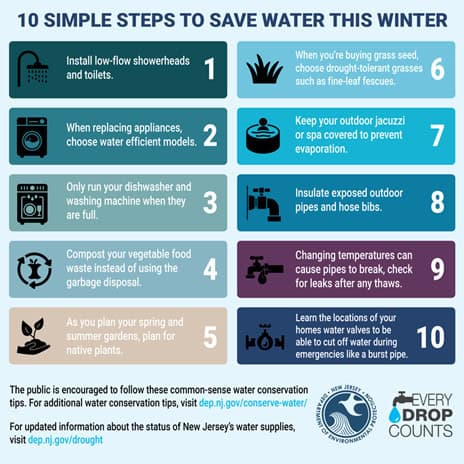
Residents are urged to adopt water-saving practices, including running dishwashers and washing machines only when full, winterizing irrigation systems, repairing leaks, insulating pipes and choosing drought-tolerant landscaping. The DEP also recommends using commercial car washes that recycle water and replacing older plumbing fixtures with low-flow versions.
More information, including the full Administrative Order and regional drought status, is available at njdrought.org. Conservation tips and water-efficient appliance guidance are available at dep.nj.gov/conserve-water and dep.nj.gov/appliancestandards.

The folks who run all these data centers should be encouraged to find more efficient means to keep their computers cool. They are taking large amounts of our precious water to cool the systems, but put none back. It just evaporates into thin air. The AI race is leading to many accomplishments that were never thought possible, but at the expense of our precious natural resource. Don’t get me started on the havoc they are causing to the electric grid and our wallets.